Tbilisi State Medical University, Georgia.
Irine Zarnadze
Email: i.zarnadze@tsmu.edu
Received : Jun 11, 2025 Accepted : Jul 03, 2025 Published : Jul 10, 2025 Archived : www.meddiscoveries.org
Aim: The aim of this article is to examine the challenges, which are faced by Georgian Healthcare system regarding fulfilling the Sustainable Development Goals (SDGs) in recent years. It is important to mention, that due to changed world healthcare priorities, the governments are trying to adapt their countries healthcare systems to better respond to the updated requests from the population and technological progress. Nowadays, there is a rapidly changing healthcare environment, geopolitical background and increased expenditures on health globally. By this article, we are trying to discuss the sustainability of healthcare systems of several EU countries, such as Latvia, Lithuania, Estonia, Spain and Sweden in comparison to Georgia.
Methodology: The analysis of literature on health promotion, sustainable development goals were conducted to find the links connecting health promotion and sustainable development goals considering data of European countries in relation to Georgia. In the process of work, we have also used the methods of comparative analysis and based on it we have made conclusions.
Results: We have found that, the inequalities in health care access still exist. To bridge this gap and ensure equitable healthcare provision, addressing disparities is critical. Various determinants of health need attention, in order to find the way for achieving our common objective of Health for all and achieving the Sustainable Development Goal targets [1]. We have examined the several European countries demographic and socioeconomic context, access to Healthcare services, Health system resources key indicators, Health status key indicators, new technologies development and resources, performance of healthcare systems etc.
Conclusions: The sustainable improvement has been made since the beginning of the healthcare reform in Georgia, but the ever-changed world, new challenges, technological development, progress in financing systems enables countries to transform their healthcare systems continuously, and of course, Georgia is not the exception.
Keywords: Health care system; Sustainable development goals; Challenges.
Ensuring healthy lives for all requires a strong commitment, but the benefits outweigh the cost. Healthy people are the foundation for healthy economies. Countries worldwide are urged to take immediate and decisive actions to predict and counteract health challenges. This becomes especially critical in safeguarding vulnerable population groups and individuals residing in regions burdened by high disease prevalence. By doing so, we can strengthen health systems and foster resilience in the face of health adversities [1].
Universal Health Coverage (UHC) aims to ensure that everyone can access quality health services without facing financial hardship. While efforts to combat infectious diseases like HIV, TB and malaria led to significant expansions in service coverage between 2000 and 2015, progress has since slowed. Inequalities continue to be a fundamental challenge for UHC. Coverage of reproductive, maternal, child and adolescent health services tends to be higher among those who are richer, more educated, and living in urban areas, especially in low-income countries. You can start by promoting and protecting your own health and the health of those around you, by making well-informed choices, practicing safe sex and vaccinating your children. You can raise awareness in your community about the importance of good health, healthy lifestyles as well as people’s right to quality health care services, especially for the most vulnerable such as women and children [1].
Government, local leaders and other decision-makers are accountable to their commitments to improve access to health and health care for ensure basic healthcare services free of charge.
| Demographic factors | Georgia | Estonia | Lithuania | Latvia | Sweden | Spain | EU |
|---|---|---|---|---|---|---|---|
| Population size | 3 736 400 | 1 331 796 | 2 805 998 | 1875 757 | 10 452 326 | 47 432 893 | 446 735 291 |
| Life expectancy at birth (2022) | 73.7 | 78.2 | 76 | 74.8 | 83.1 | 83.2 | 80.7 |
| Socioeconomic factors | |||||||
| GDP per capita (EUR) | 8 210 (USD) | 30 671 | 31 481 | 25 939 | 42 264 | 29 808 | 35 219 |
| Unemployment rate (%) | 17.3 | 5.6 | 6.0 | 6.9 | 7.5 | 12.9 | 6.2 |
Analyzing the above-mentioned indicators, we can conclude that Georgia has the highest unemployment rate and lowest GDP per capita amongst these countries. The government should increase employment programs and pay more attention to the healthcare expenditure rate.
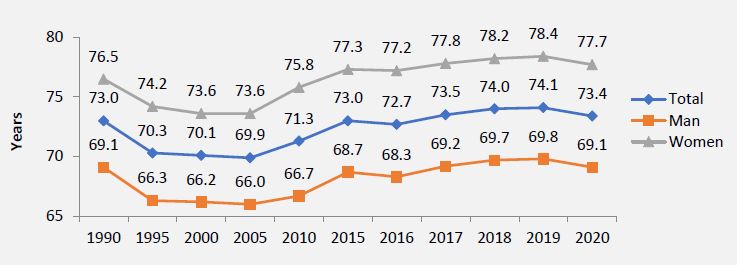
Life expectancy at birth has been steadily increasing over the last three decades, but in 2020, due to the novel coronavirus pandemic, it decreased by 0.7 years to 73.4 years (2010 - 71.3 years). There is a significant difference between the life expectancy of men and women - 8.6 years. Statistics show that women’s life expectancy is 8.6 years higher than men’s [8].
Life expectancy at birth has been steadily increasing over the past two decades. In 2019, the highest rate was recorded - 74.1 years. However, in 2020, due to the pandemic caused by the new coronavirus, it was again reduced by 0.7 years. In the country, there is a rather high difference between the average life expectancy of men and women (8-9 years on average). The reasons for this difference are not biological, but social and gender-related (Figure 1).
The Georgian Government’s Resolution No. 230 of May 2, 2022 approved the National Health Protection Strategy of Georgia for 2022-2030, which describes in detail the strategic directions necessary for the development of the health care system.
According to the World Bank classification, Georgia belongs to the group of countries with higher-than-average incomes (2020). Gross domestic product per capita increased from $3,233 (2010) to $4,256 in the last decade (Geostat). Poverty rates have also decreased (absolute poverty rate of $1.9 per day - 2010 - 12%, and in 2019 - 3.8% (Geostat) [9].
During the last decade, positive trends are reflected in the index of social inequality (Gini coefficient - 0.42 in 2010 and 0.36 in 2020) [9] and in the direction of reducing unemployment (27.2% in 2010 and 20.6% in 2021) [10].
In the process of studying health care system in Georgia, we have used the method of analysis. Based on it we have studied the sustainable development goals, which directly or indirectly affecting health care. By comparing the European countries data, we attempted to evaluate the best example for Georgia. In the process of work, we have also used the methods of comparative analysis and made conclusions.
Financing the health care system: Since 2013, the government of Georgia has laid the foundation for a health policy focused on the health and well-being of the population. The universal health care program was launched, with which the state created a mechanism for protecting each citizen from the catastrophic costs of medical services. Since 2017, the main principle of financing the program has been based on citizens’ income and has become more need-oriented and socially fair. Replacing the public insurance model of targeted groups with a universal health care program has successfully reduced the fragmentation of health care financing at the national level. At the same time, government spending on health care has increased and effective steps have been taken to achieve universal coverage [8].
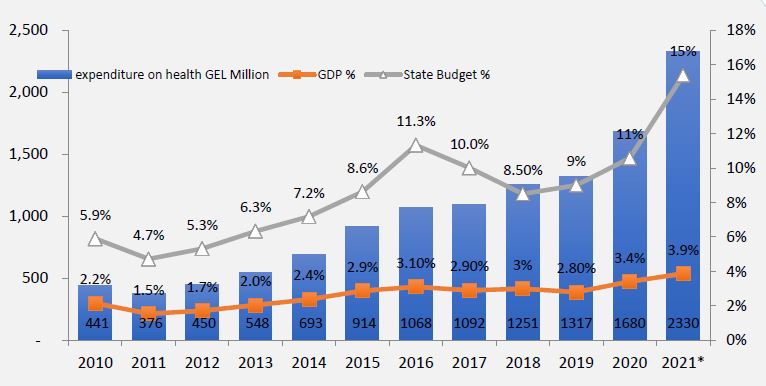
As a result of the introduction of the universal health care program, the state expenditures on health care almost doubled (2012 - 450 million GEL, 2020 - 1680 million GEL, and 2021 - 2330 million GEL), which indicates the growing priority of health care in the state budget allocation process. It should also be noted that in 2020-2021, the sharp increase in public spending on health care is largely related to the new coronavirus pandemic. Despite the sharp increase, compared to other countries in the European region, the share of public spending on health care in GDP (3%) still lags behind the UN Universal Health Declaration to the specified limit of 5% (Figure 2) [8].
| Share of GDP | Georgia | Estonia | Lithuania | Latvia | Sweden | Spain | EU |
|---|---|---|---|---|---|---|---|
| % | 3.9 | 7.5 | 7.8 | 9.0 | 11.2 | 10.4 | 11.0 |
Per capita health expenditure has grown steadily, and in 2021 it has reached 3.9 %, of course it is still low, less than EU average on health per capita (11%).
The budget required for the implementation of the three-year action plan for the implementation of the National Health Strategy for 2022-2030 is 42.8 million GEL. Out of this, the state budget expenditure is 9.3 million GEL, and the funds allocated from external financing sources and other sources available in Georgia amount to 12.0 million GEL. In order to fully implement the plan, it will be necessary to mobilize 21.5 million GEL [8].
This document is a strategic document for the development of the health care system of Georgia for the years 2022-2030, reflects the vision of the development of the health care system in the country for the next 9 years and defines the main values and principles regarding the right to health care.
It is interesting to consider the relationship between the strategy and international development framework documents. The National Health Protection Strategy responds to the new agenda document “Transforming our world: the 2030 Agenda for Sustainable Development” adopted at the United Nations General Assembly Summit in New York on September 25, 2015, which was formed into the so-called global goals of sustainable development and the large-scale vision of the world’s prospective development. represents a strategy. In 2019, the Government of Georgia approved the National Document of Sustainable Development Goals and undertook to fulfill them by 2030. The 3rd goal of sustainable development - “Achieving a healthy life and well-being for people of all ages” is dedicated to the protection of the population’s health and achieving justice in health care and is implemented under the supervision of the Ministry [8].
To assess the general progress of the SDG, the so-called Global SDG index, which is a composite indicator of the achievement of all goals. According to this index, Georgia ranks 56th among 165 countries with a score of 72.2 and exceeds the regional average by 0.8% (Institute for Health Measurement and Evaluation (IHME)).
In terms of increasing access to healthcare in Georgia, the most important achievement was the implementation of the universal healthcare program in 2013 which led to the universal coverage of the population with state-funded healthcare services. The WHO Regional Office for Europe (WHO/Europe) has recognized the universal healthcare program as a successful project in the European Health Report for 2015 [12].
The main priority of the Government of Georgia is to ensure a universal accessibility to quality healthcare services which was reflected in an unprecedented increase in the volume of state appropriations allocated to the healthcare sector (GEL 450 million in 2012, GEL 1 billion in 2017). However, Georgia’s indicators are still low when compared to the internationally recognized data on the efficiency of the healthcare funding system. According to 2015 data, the share of state expenditures on healthcare in GDP was 2.9% (the average rate in Europe is 5.7%) while the share of state expenditures on healthcare in the state budget was 8.6%. Despite the decrease, the share of Out-Of-Pocket payments (OOP) (57.3%) in the total expenses for healthcare is still considerably high, imposing a heavy burden on households. The share of expenditures on ambulatory medications (38%) is critically high in national expenditures on healthcare and it is mainly made up of out-of-pocket expenses. Expenses on preventive and primary healthcare services (19%) are still limited and volatile when compared to hospital expenses (31%).
Objective: Improve the efficiency of the system of healthcare funding considering universal healthcare principles [12].
Health in the 2030 Agenda three core documents define the role of health in sustainable development in the WHO European Region: the 2030 Agenda (2); Health 2020, the European policy for health and well-being [3]; and the WHO Regional Office for Europe’s roadmap to implement the 2030 Agenda, which was adopted in 2017 [4]. The WHO roadmap aims to strengthen the capacities of Member States to achieve better, more equitable and sustainable health and well-being for all at all ages in the WHO European Region. It advocates high-level leadership for health and well-being and strong intersectoral mechanisms to address the many risk factors and determinants of health. It focuses on approaches involving the whole of government and the whole of society and the consideration of Health in All policies [4]. The SDGs comprise 17 goals and 169 targets and were approved on 25 September 2015 under the United Nations General Assembly resolution 70/1 [2]. The SDGs form a call upon all countries to strengthen their efforts for improving equity and quality of life for all people. The SDGs follow on from the Millennium Development Goals, which covered the period 2000-2015, and transformed these into a more comprehensive action plan targeting the elimination of poverty and creation of balanced economic growth worldwide. The 2030 Agenda has three core principles that are particularly relevant to country strategies and approaches to achieving health and well-being for all: interconnectedness and indivisibility, leaving no one behind and inclusiveness. The core health SDG is SDG 3: to ensure healthy lives and well-being for all at all ages. This SDG enshrines the global commitment to foster healthy societies and protect the rights of everyone to enjoy the highest attainable standard of physical and mental health. SDG 3 has 13 targets that are intended to address major health priorities, including Sexual and Reproductive Health (SRH); maternal and child health; communicable, non-communicable and environmental diseases; Universal Health Coverage (UHC); and access for all to safe, effective, quality and affordable medicines and vaccines. Health and well-being for all are also addressed directly and indirectly by many of the other SDGs and there are over 20 health-related targets across all the 17 SDGs. Pursuing other goals can directly and indirectly benefit human health and well-being, and implementation of the SDGs will contribute to the full achievement of human rights and fundamental freedoms for all, including the right of everyone to the enjoyment of the highest attainable standard of physical and mental health. The 2030 Agenda envisions a new dynamic between the SDGs in which good health and other goals are closely connected and interdependent. Progress towards one goal should contribute to the achievement of others [13].
The Government of Georgia has been covering basic outpatient, inpatient and emergency services to all uninsured citizens through the UHCP since 2013, which nowadays covers 90% of the population. Thus, important to mention that the following the SDGs, the Government of Georgia continues to work on strengthening the healthcare system towards achieving quality health care for all citizens of Georgia. Going forward, it remains important to closely monitor the progress and the impact of these actions on the health and well-being of the population in the country.
One of the most important issues globally was pandemic period, when the countries faced difficulties and challenges, which are still a big burden for them. Health spending increased substantially during the Covid-19 pandemic in all countries. Following the emergence of a new coronavirus (SVS-CoV-2) disease (COVID-19), the Ministry of Internally Displaced Persons from the Occupied Territories, Labour, Health and Social Affairs of Georgia has implemented a number of effective and targeted measures to stop the spread of the infection in the various types of institutions under control of the Ministry.
In order to implement the relevant measures, LEPL State Care and Trafficking victims Assistance Agency was provided with general recommendations and educational materials related to COVID-19 for Boarding houses of Persons with Disabilities and Elderly under the supervision of the Agency and also for the services for Persons with disabilities, elderly and children without parental care and in the frames of “State program of Social Rehabilitation and Child care”.
On the other hand, the LEPL State care and Trafficking Victims Assistance Agency provided the relevant legal act, which regulated the measures to be taken to prevent the spread of COVID-19 not only at the branches, as well as at the central apparatus of the Agency.
According to the Order of the Minister of Internally Displaced Persons from the Occupied Territories, Labor, Health and Social Affairs of Georgia N01-123 / O dated March 25, 2020 “on the Measures to be taken to prevent and control the spread of infection (COVID-19) caused by the new coronavirus (SARS-CoV-2)” considering the recommendations of the World Health Organization, a number of measures have been taken to prevent and manage the spread of infection (COVID-19) to different types of institutions in the country [14]. Among them are recommendations on “preventing the spread of a new Coronavirus Disease (COVID-19) in public care facilities 24 hours a day”, “Infection with COVID-19 due to a new Coronavirus (SARS-CoV-2) infection in people with disabilities”, which is designed for disabled people and their caregivers, “Readiness and response to the spread of infection with the new Coronavirus (SARS-CoV-2) (COVID-19) in long-term care homes”, because they are the most vulnerable population to the COVID-19 pandemic and are at increased risk of morbidity and mortality from this infection.
− 24-hour services are provided by individual protection equipment.
− Screenings of the beneficiaries and the staff at 24-hour care homes on new Coronavirus (SARS-CoV-2) infection are planned according to the order N01-144 / O of April 1st, 2020 of the Minister of Internally Displaced Persons from the Occupied Territories, Labour, Health and Social Affairs of Georgia “On Approval of the Laboratory of Laboratory Diagnosis of Infection (COVID-19) Caused by New Coronavirus (SARS-COV-2)” considering the approved laboratory diagnostic algorithm [15].
Despite the difficulties, the Covid-19 crisis in Georgia has created significant opportunities to strengthen the hospital sector and introduce new digital technologies in primary healthcare. The initiatives launched during the pandemic will create a good foundation for further strengthening of the hospital and primary care network during the period of the present strategy.
In total, to respond to Covid-19, the Government of Georgia has mobilized more than 1,317.2 million GEL in the health budget in 2020-2021, medical services related to the infection of Covid-19 are fully covered by the state [12].
Finally, the global experience of the Covid-19 pandemic has clearly demonstrated the key role of vaccination in reducing the morbidity, hospitalization and mortality associated with Covid-19, restoring normal life and economic stability in countries.
Country’s Recovery and Resilience Plan includes investment in health sector over the period 2025-2030, focusing on boosting high-tech medical equipment, improving health system preparedness, strengthening health promotion and digital transformation of healthcare. the action plan covers all spheres of healthcare, starting from prevention and including rehabilitation services, reflecting important lessons from the pandemic experience.
While assessing the healthcare system, we have found the urgent necessity to continue reforming the healthcare system. Accordingly, the percentage of GDP on health care must be increased to ensure the adequate healthcare performance. It is less than EU range (5%), in 2020 it was 3.6%, 3.9 % in 2021 - in Georgia. The Government of Georgia must pay more attention on the challenges, which have been aroused during the pandemic period in the country. It is important to take into consideration the several EU countries’ experience, such as Lithuania, Latvia and Estonia.
Of course, the sustainable improvement has been made since the beginning of the healthcare reform in 2013, but the ever-changed world, new challenges, technological development, progress in financing systems enables countries to transform their healthcare systems continuously, and of course Georgia is not the exception. Georgia has the highest unemployment rate and lowest GDP per capita in relation to European countries. The government of Georgia should increase employment programs and pay more attention to the healthcare expenditure rate. It is also remains important to monitor the progress and the impact of governmental actions on the health and well-being of the population in the country, these includes changes in the legislation and expansion of healthcare, social and employment programs.
Ethical approval and participants’ consent: The work did not demand ethical approval, participants’ consent, or trial registration.
Declaration of conflicting interests: The authors have no conflicts of interest to declare.
Funding: The authors received no financial support for the research, authorship, and/or publication of this article.